
Review MAUDE evidence for your product codes.
Bring one FDA product code. See available source records, provisional AI summaries and analysis coverage in a 30-minute walkthrough. Your team checks the evidence and owns each review decision.
Growth is $499/month. Try Growth for 14 days with no credit card.
Watch the product demo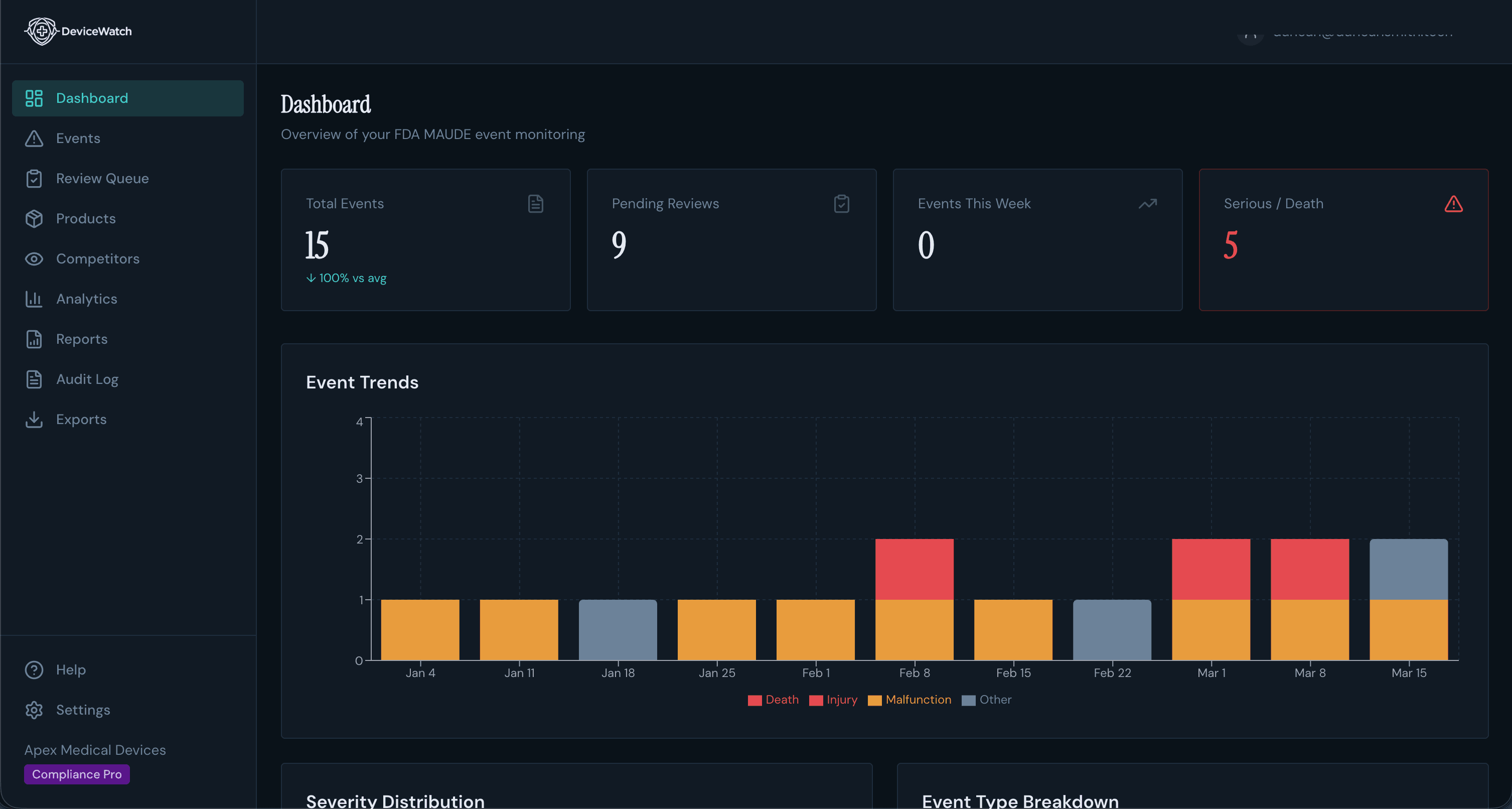
Built for regulated environments
Public FDA sources, handled with care
Source records come from public FDA datasets. Narratives can contain sensitive details and require appropriate handling.
Signed, attributable review decisions
Signed reviews bind identity, meaning and server time to the action. Validate the workflow for your intended use.
Hash-chained, tamper-evident audit trail
Governed record changes commit with their audit entries. Compliance Pro adds chain verification and audited exports.
Watch the 2-Minute Demo
See DeviceWatch Work Through a Day of FDA Reports
From raw FDA MAUDE narratives to reviewed, audit-ready intelligence — the whole pipeline in under two minutes.
- 0:00The 2,000-reports-a-day problem
- 0:35Automated MAUDE ingestion
- 0:47AI summaries + human review
- 1:11Signals, recalls & 510(k)
- 1:28Part 11 audit & one-click reports
The Problem
The Data Is Growing Faster Than Any Team Can Read It
A large reporting dataset still needs careful interpretation and qualified review.
~8,600
adverse events a day in 2022, the same 3.1M spread over the year
The Review Workflow
From Source Records to Documented Review
Follow the available evidence from collection through analysis and signed review. Coverage stays visible so your team can see what is still missing or waiting for processing.
Monitor Your Product Codes
Add your product codes once. DeviceWatch checks FDA MAUDE on a schedule and matches available records to your products. Coverage and freshness views show what has been collected and what still needs processing.
Review Related Device Reports
Review reported problems for related devices alongside your own. Use those records to frame questions for investigation; MAUDE counts do not establish comparative safety or adverse-event rates.
More monitor capabilities (2)
Alerts With Delivery Status
Critical analyses enter a delivery queue for eligible email and webhook destinations. Delivery status shows retries and held attempts; detection depends on source updates and analysis coverage.
A Digest of Available Analyses
Scheduled email digests group available analyses by severity. Delivery depends on your preferences, current analysis coverage and successful processing.
Provisional Summaries for Human Review
When a narrative is available and processed, AI extracts reported failure modes, severity and patient outcomes. Review the provisional findings against the source. Missing analysis and unknown findings stay visible.
Record Your Review Decision
Your team can acknowledge, flag or reject analyzed records. Signed review actions record the reviewer, time and decision in the audit trail.
More analyze capabilities (2)
Explore Patterns in Collected Records
Explore report counts, provisional severity findings and failure patterns in collected data. Check collection and analysis coverage before interpreting a chart.
Investigate Signals in Compliance Pro
Compliance Pro surfaces configured volume and severity signals from available data for investigation. Your team checks the evidence and decides whether action is needed.
PSUR Drafts With a Source Trail
Compliance Pro assembles provisional periodic safety update reports with available analyses, trends and retained evidence. Your qualified team checks coverage and validates the report for its intended use.
Link Investigations to Source Evidence
Compliance Pro links safety signals, investigation notes and CAPA actions to retained evidence, with every status change logged to the audit trail. Your team owns the investigation, rationale and follow-up.
More act capabilities (2)
Reports With Retained Evidence
Generate provisional PDFs with retained evidence. Custom templates require Compliance Pro. Your qualified team checks coverage, review status and evidence limitations before using a report.
Your Data, Your Workflows
Use the read-only REST API to retrieve available surveillance records for your own tools. Governed review decisions stay in DeviceWatch.
See It In Action
Built for Regulatory Professionals
Every screen designed around the workflows your team actually uses.
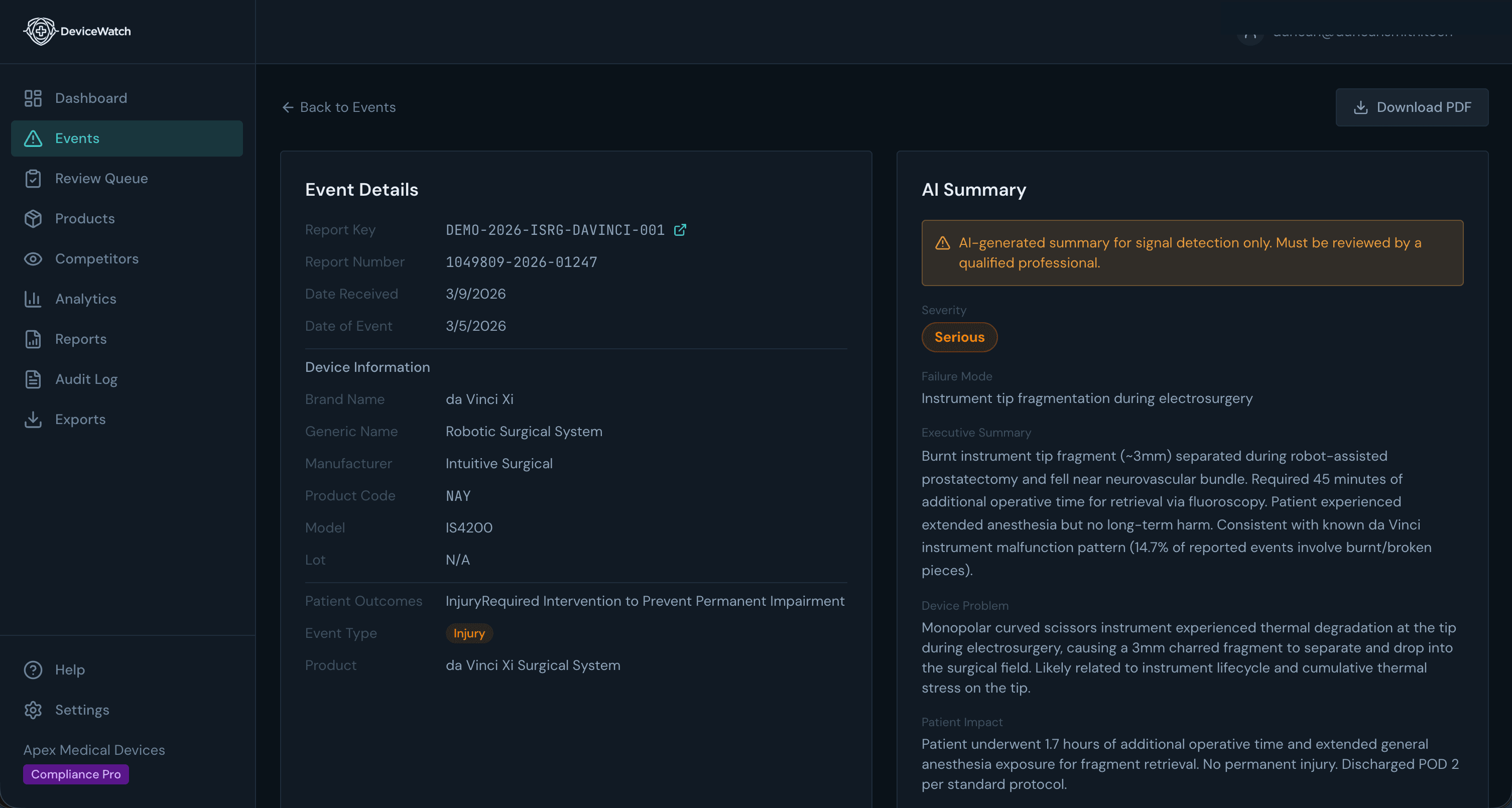
AI-Powered Analysis
Narrative Analysis for Human Review
Dense FDA narratives distilled into actionable summaries. Device information, failure modes, severity and patient outcomes are extracted for your team to review.
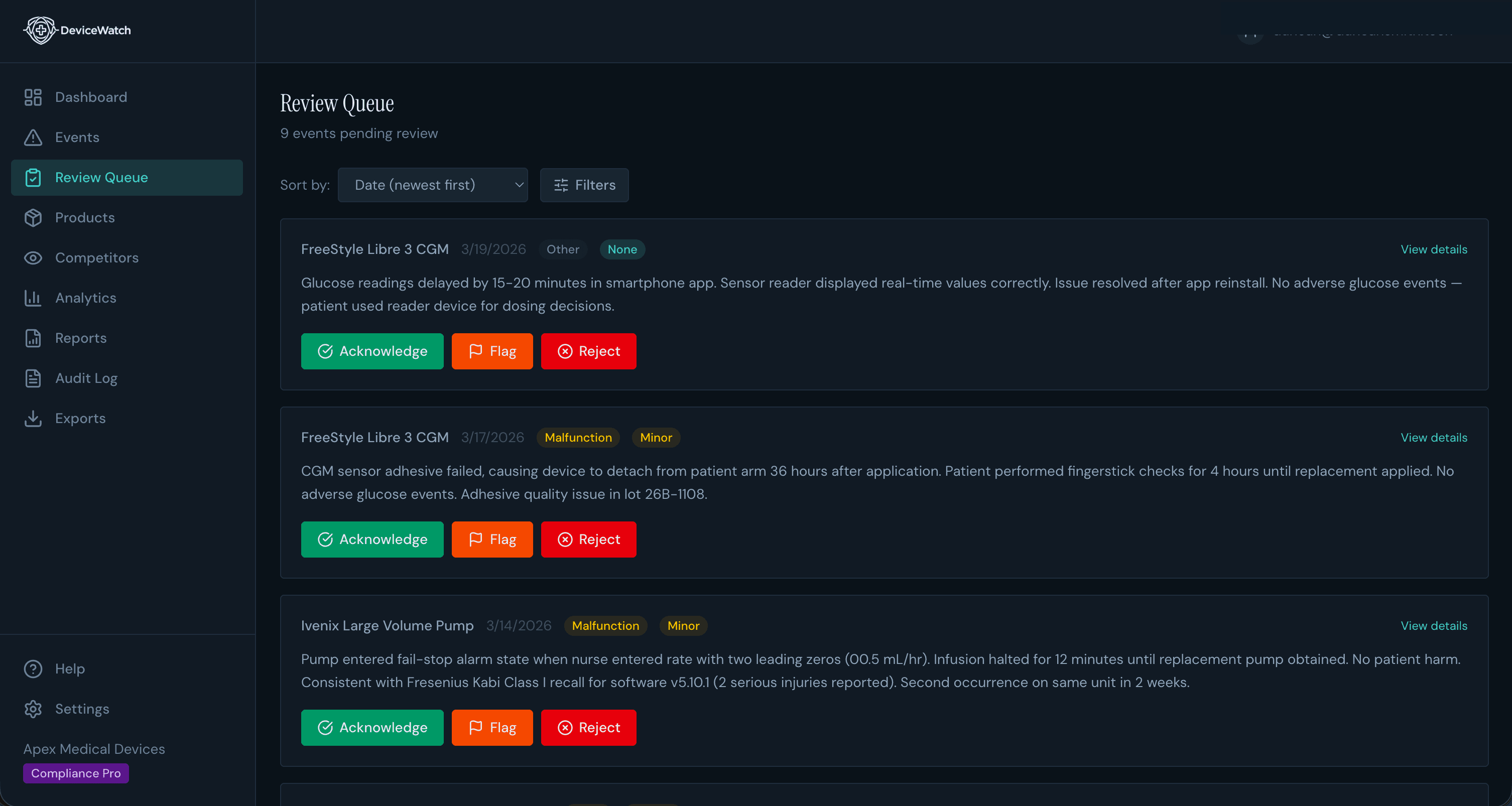
Human-in-the-Loop
AI Finds It. You Verify It.
Qualified reviewers acknowledge, flag or reject analyzed records. Signed decisions retain identity, meaning and server time in the audit trail. Reports remain provisional and require a separate coverage and evidence check.
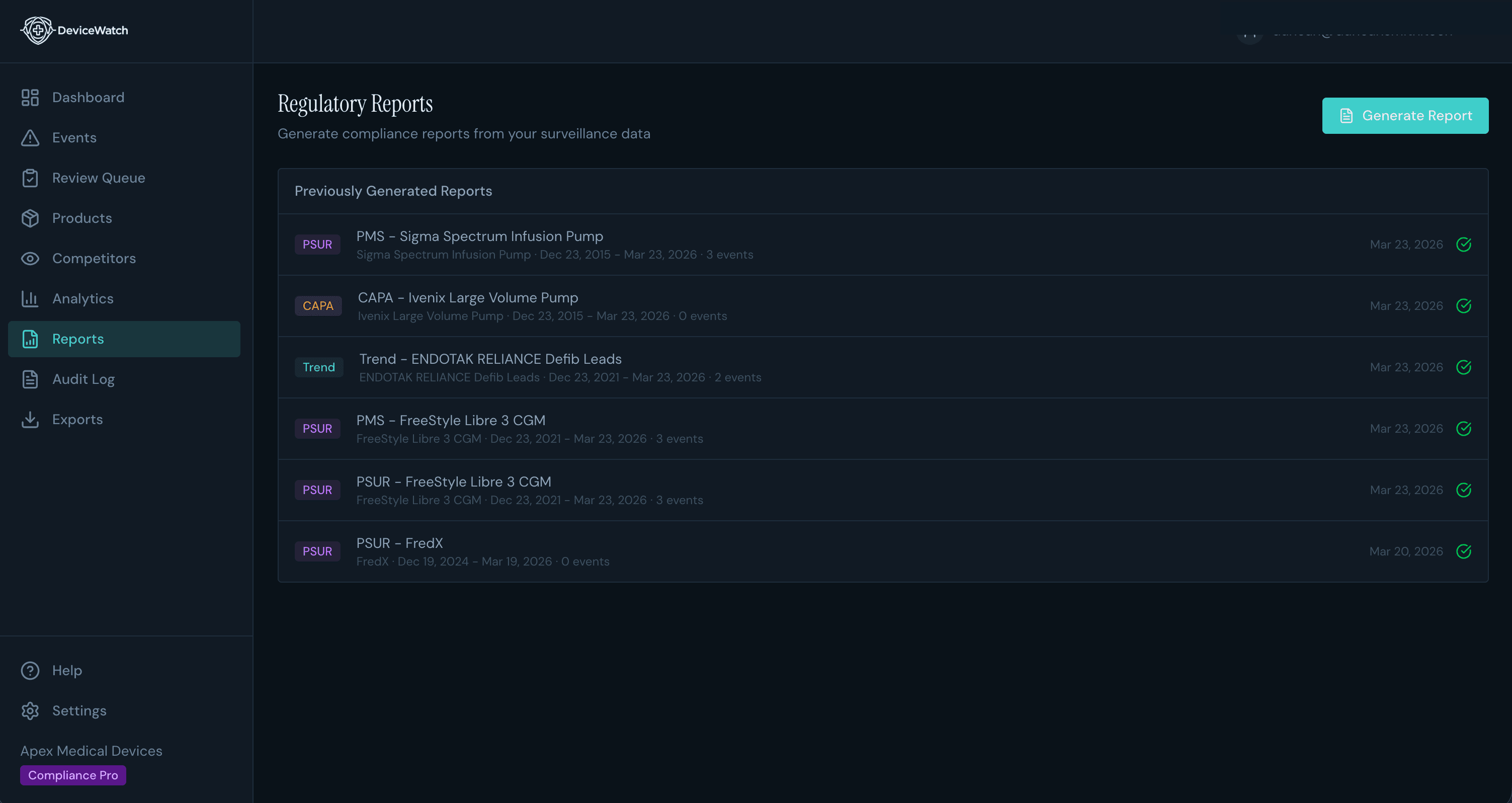
Provisional reports with retained evidence
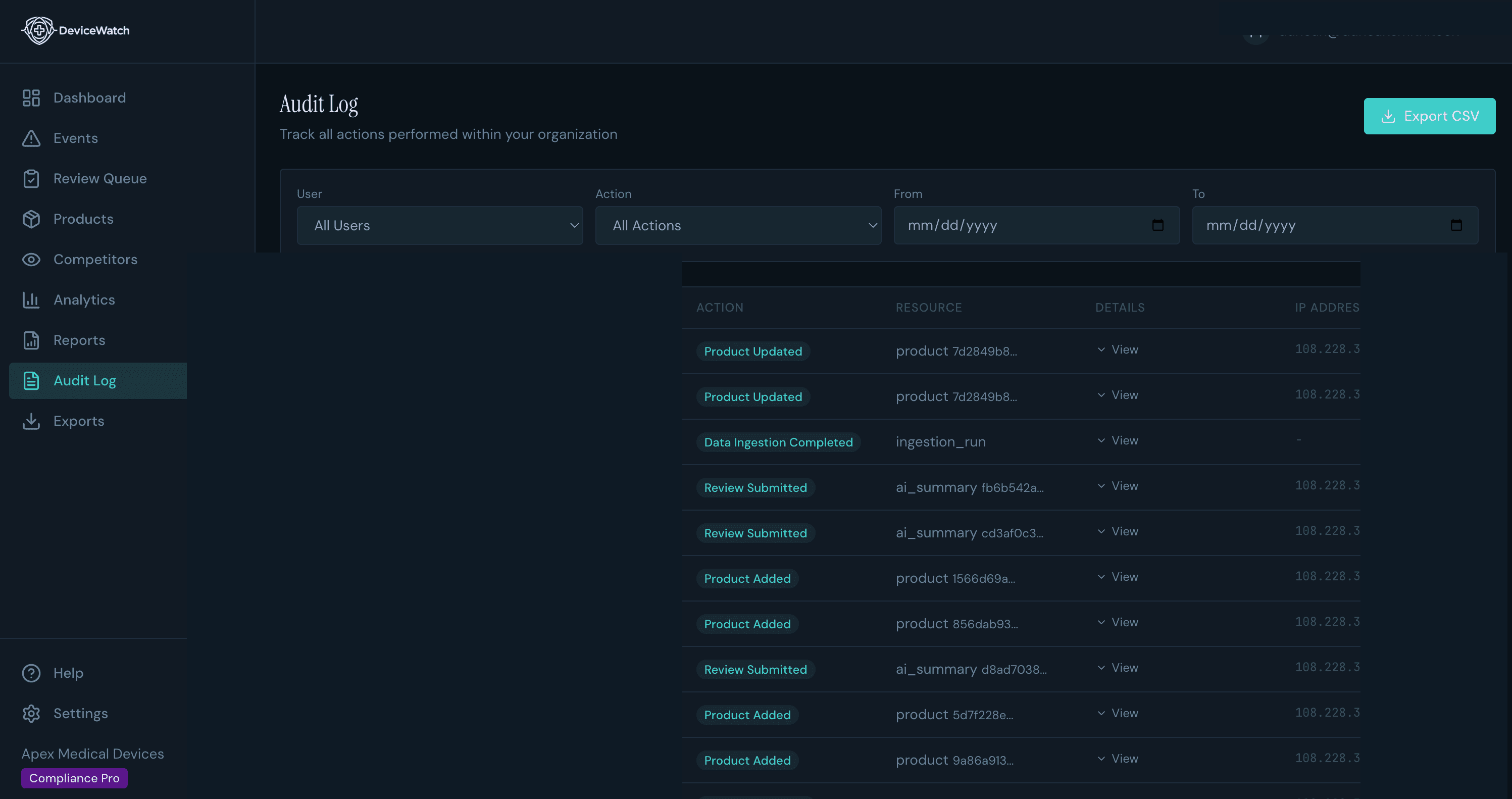
Attributable review actions and audit history
How It Works
Collection, Analysis and Human Review
DeviceWatch ingests FDA adverse event data, applies AI analysis, and brings reviewable surveillance findings to your team.
Data Sources
MAUDE Reports
openFDA device/event API
MAUDE Bulk Files
FDA monthly delta updates
FDA Recalls
Enforcement records
510(k) Clearances
FDA premarket notifications
AI Intelligence Engine
Signal Detection
Failure Clustering
AI Summarization
Competitor Analysis
Severity Trends
Coverage Accounting
Output & Action
Review Queue
Prioritize critical issues
PSUR & PDF Reports
Provisional drafts for qualified review
Critical Alerts
Queued email, Slack, webhook delivery
API Integration
Read-only access for your tools
Competitive Intelligence
Inspect reports for related devices
Review reported failure modes and patterns
Document questions for investigation
Workload scenario
Model your surveillance workload
Set your team's workload and an assumed reduction. See the time still needed for review and the subscription cost.
Starting values are examples, not customer results. The reduction starts at 0% until you set your own assumption.
Growth covers up to 10 team members. For larger teams, discuss Compliance Pro with us.
This is your assumption, not a measured DeviceWatch result. The 90% limit keeps some reviewer effort in every scenario. It is not a performance claim.
- Baseline workload cost per year
- $12,000
- 120 team hours per year at your hourly cost
- Modeled capacity value per year
- $0
- 0 team hours freed under your assumption
- Remaining reviewer effort per year
- 120 hours
- $12,000 of modeled team workload remains
- Growth subscription per year
- $5,988
- $499 per month × 12 months
- Net modeled capacity value after subscription
- -$5,988per year
- Modeled capacity value minus the Growth subscription. Negative values mean the subscription costs more than the capacity modeled here.
Freed time can be reassigned. It does not by itself reduce payroll. Your team still reviews source reports, checks AI output and makes decisions. Setup and training time are not included in this model.
Pricing
Choose the Workflow Your Team Needs
14-day Growth trial. No credit card. Book a walkthrough to evaluate Compliance Pro.
Growth
Competitor monitoring, severity and failure-mode analytics and provisional reports for your review.
- 15 product codes
- Competitor device tracking
- Severity and failure-mode analytics (Death and Injury reports)
- Team collaboration and signed reviews
- Provisional trend reports
- FDA recalls & 510(k) clearances
- Slack, Teams & webhook alerts
- PDF exports
- Read-only REST API access
- Hash-chained audit trail on every plan
- Priority support
Compliance Pro
Signal investigations, CAPA tracking, audit verification and provisional PSUR, PMS and CAPA summary reporting for qualified review.
- Unlimited product codes
- Audit chain verification and audited exports
- Safety signals & CAPA tracking
- Unlimited team members
- Provisional PSUR, PMS and CAPA summary reports
- Custom report templates & branding
- Priority support
Enterprise
Dedicated infrastructure, global regulatory coverage, and full validation packages for large-scale medical device organizations.
- Everything in Compliance Pro
- Part 11-ready + EU MDR/IVDR audit trails
- Automated PSUR, CER & PMCF reports
- SSO/SAML + SCIM provisioning
- Dedicated instance or on-prem deployment
- 24/7 support + named Customer Success Manager
- IQ/OQ/PQ validation package included
- Custom data retention & residency
- Unlimited API access + bulk export
- Annual contract with BAA/MSA
FAQ
Questions Before You Start
What exactly does DeviceWatch replace in our workflow?
DeviceWatch collects available FDA records on a schedule, queues narrative analysis and gives your team a review queue and report tools. Analysis coverage shows the records still waiting for processing. Your team checks the findings, records decisions and validates reports for their intended use.
How does the AI analysis work, and can we trust it?
Claude by Anthropic extracts failure modes, severity and other findings from clinical narratives. Ongoing analysis covers Death and Injury reports. When you add a product, its 20 most recent reports of any type are analyzed once. During a trial, analysis is limited to 25 reports a day. Each analysis enters a human review queue. Reports can include unreviewed or rejected analysis, so they remain provisional and state their coverage, review status and evidence limitations. Your qualified reviewers own the decisions.
Is this compliant with 21 CFR Part 11?
DeviceWatch provides role-based access, session timeouts, electronic signatures and a verifiable audit chain. Review decisions record identity and time. Report release commits the retained PDF, evidence and audit together; retained downloads are also audited. Part 11 compliance ultimately rests on your validated procedures and intended use.
Why would I track competitor devices?
Reports for related devices can help your team identify reported failure modes and questions to investigate. MAUDE is a reporting dataset, not a measure of device exposure. Its counts cannot establish adverse-event rates, compare device safety or prove that a device caused an event.
How much time will this actually save our team?
Time savings depend on the records you monitor and the review your team requires. DeviceWatch handles scheduled collection, analysis and report formatting. Coverage and review counts show the work still outstanding; your team validates the findings and decides how to use them.
We already have a QMS. How does this fit?
DeviceWatch supports the surveillance portion of your quality workflow: scheduled FDA record collection, provisional analysis, signed review and report preparation. Use exports or the read-only API to retrieve records for your existing tools. Your QMS and validated procedures remain part of the process.
What data sources does DeviceWatch monitor?
DeviceWatch ingests FDA MAUDE adverse-event records from openFDA and FDA bulk files, plus FDA recalls and 510(k) clearances through openFDA. Scheduled jobs match available records to your monitored products. Updates are periodic, not immediate. Additional international sources remain on the roadmap. The inputs are public FDA records; narrative content still requires appropriate handling.
How do you handle changes to FDA data sources?
DeviceWatch currently collects MAUDE records through openFDA and FDA bulk files, plus recalls and 510(k) records through openFDA. We monitor upstream data channels for changes. Check the in-app collection and analysis status when assessing what is available for your review.
Can I try it before committing?
Growth includes a 14-day free trial. No credit card required. For Compliance Pro features such as PSUR and PMS reports, book a walkthrough before choosing a paid plan. Add your product codes, and the most recent records for each are collected and queued for analysis (initial ingestion is capped per organization each hour, with analysis coverage shown in the app). Review the available records and workflow before deciding whether to subscribe.
TrendWatch
A closer look at public device-safety records.
A free brief for RA/QA teams with public recall records, reported problems and questions for further review. See what’s inside →
Start With One Product Code
Review available records and analysis coverage with us, then decide whether a Growth trial fits your workflow. Growth is $499/month after a 14-day trial; no credit card is required to start.